Over the course of my career, I have learned a great deal — mostly the hard way — working on all sides of the philanthropic table. Most lessons came through gradual evolution; acquiring experience over time, working with colleagues, mentors and donors. But there was one moment that resembled a true epiphany.
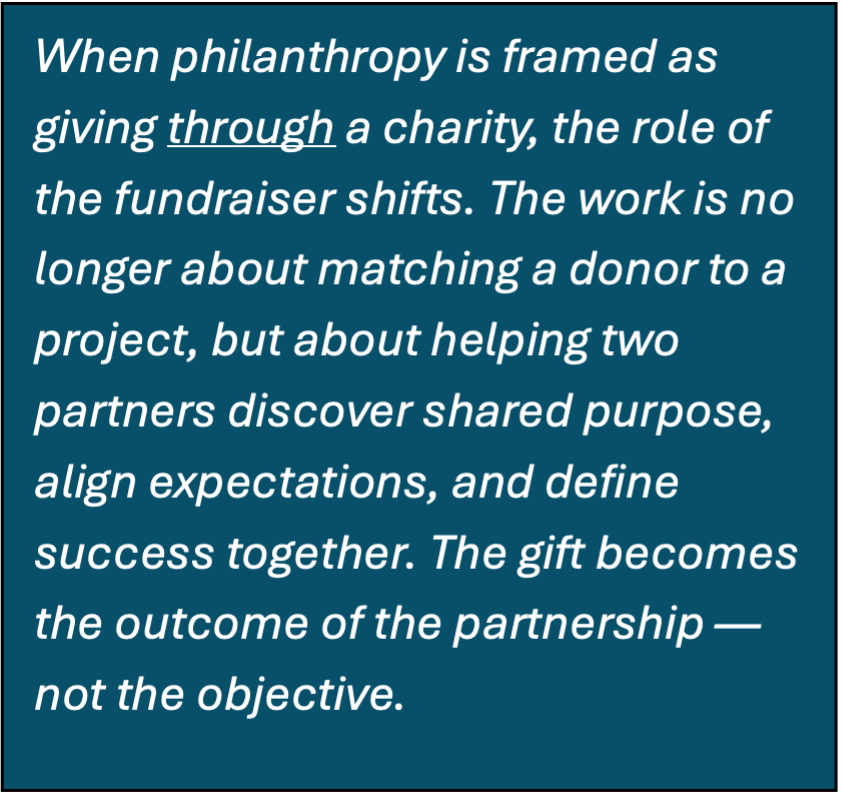
That epiphany came courtesy of Jim Langley, a wise Maryland-based fundraising consultant with whom I first crossed paths a dozen years ago. Jim advised that the best way to think about philanthropy is not in terms of a donor giving to a charitable organization, but giving through it. I have considered him a mentor ever since.
 The concept is simple, yet disproportionately powerful.
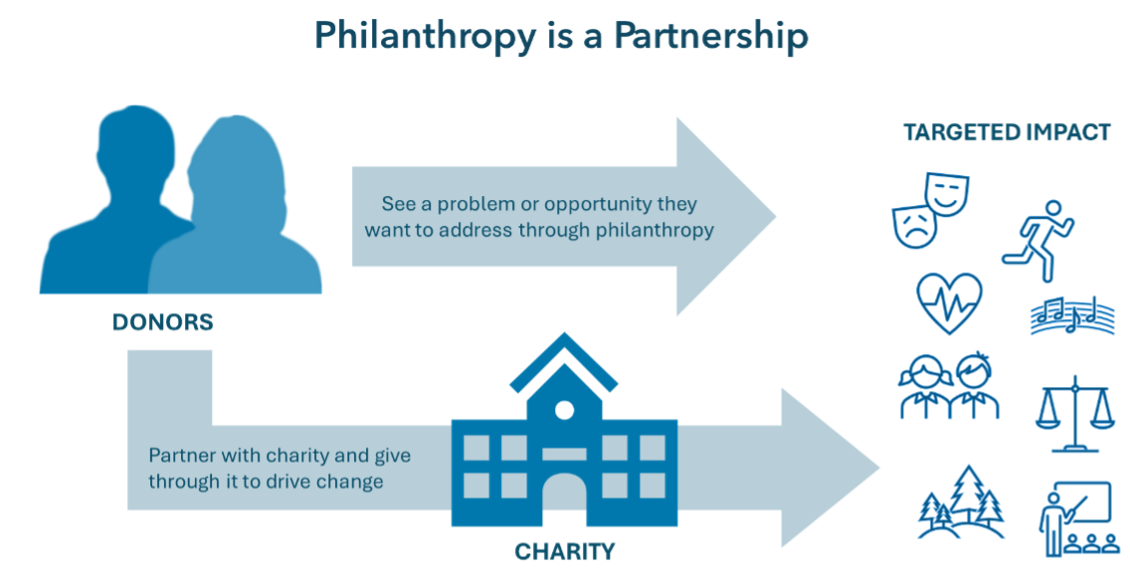
Effective philanthropy feels like a genuine partnership between a donor and a charity. At its foundation is shared interest. For their own reasons, both parties care deeply about a community or societal issue and want to do something to address it — to solve the problem or at least reduce its prevalence.
Neither party can do this alone. The donor may have the financial resources, but typically lacks the front-line knowledge, experience and operational capability to know precisely what needs to be done or how best to do it. The charity, in contrast, has the expertise, insight, and on-the-ground capability but insufficient resources to fully execute what needs to be done.
When donor and charity join forces — bringing both capital and capability to the table — they can accomplish something that matters deeply to both, but which neither could achieve independently.
So, what is really happening here?
What does the donor truly care about? Is it the charitable organization itself, or its mission? We all know the answer is the latter. Donors want to make a difference. They want their giving to have impact. In practical terms, they are giving through the charity to achieve that end.
This framing is deceptively simple, but it has the power to re-orient everyone involved in philanthropy (donors, advisors, and charities alike) to think more ambitiously and more purposefully about their roles.
For donors, thinking this way encourages a deeper connection to purpose. It keeps what they truly care about squarely in focus and can lead to more thoughtful, productive engagement with organizations working on the issues that matter most to them.
The concept is equally important for charities. It invites them to think about philanthropy in a richer and more balanced way. Rather than viewing it as a transaction where one party gives and the other receives, it reinforces the idea of partnership, where both parties bring something of real value. It also moves charities away from a default posture of subservience, and away from the notion of gifts as “handouts,” toward a role as a true partner whose contribution is every bit as important as the financial gift.
For those responsible for bringing these partners together (most often, though not always, development professionals) the “giving through” concept can be especially powerful. It raises sights beyond the narrow goal of securing a signed gift agreement, toward the higher purpose of building a meaningful, accountable partnership for a greater good.
When all parties are clear about shared purpose, goals, expectations and accountabilities, the relationship between donor and charity becomes richer, and often more productive than any of them initially imagined.
Like Jim Langley, whenever I speak to boards, staff, or anyone else who will listen, I always plead: “If you take one thing away from this conversation, let it be this.”
Peter Fardy is Principal, Northport Philanthropic Advisory Services.